
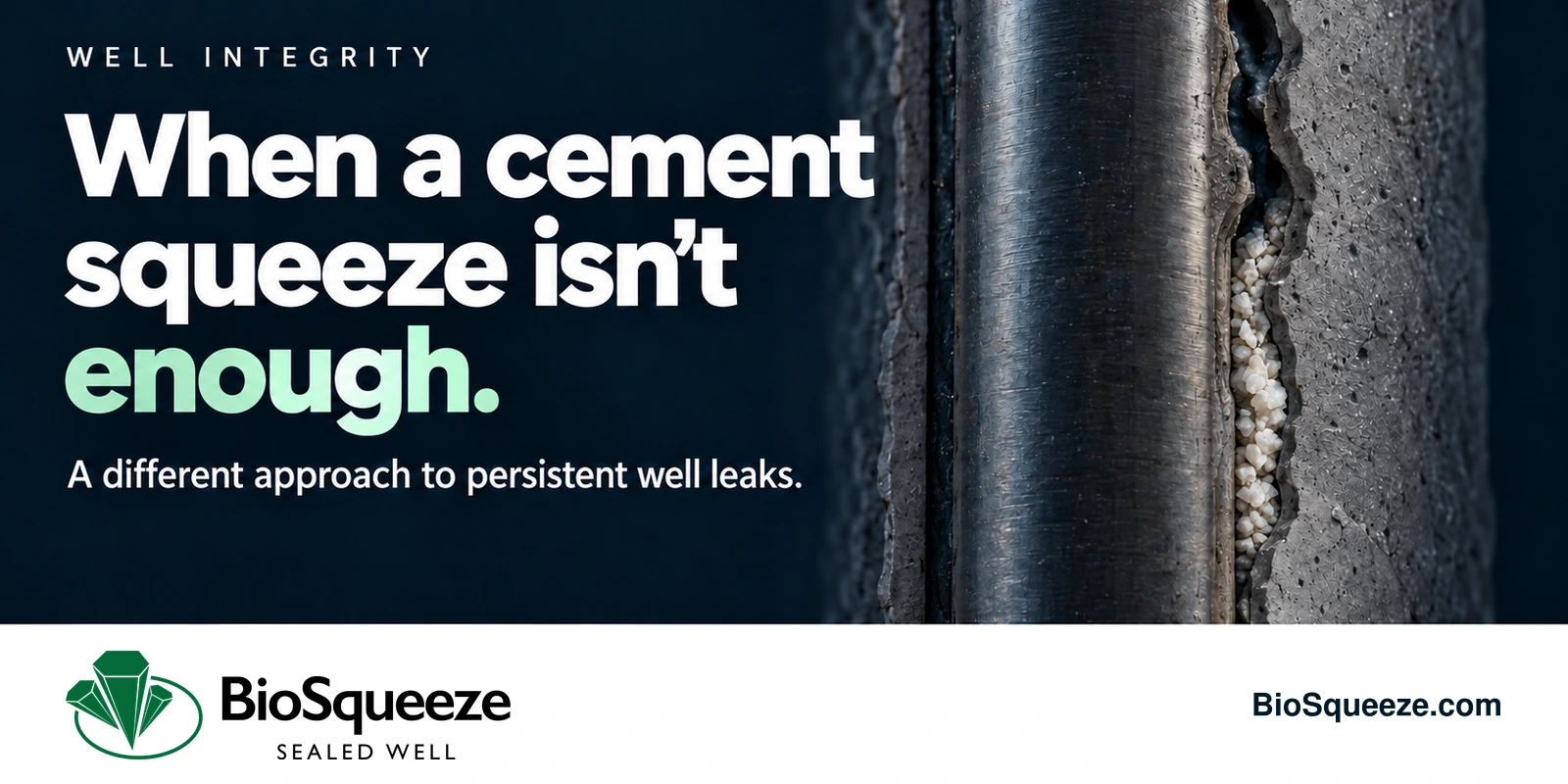
When gas flow or annular pressure persists after a cement squeeze, the next remediation plan needs to explain how it will reach the remaining leak. Another squeeze may be appropriate. In other wells, revised access, additional diagnostics, or a different sealing mechanism may offer a better fit.
The distinction matters in producing wells, storage and disposal wells, and plugging and abandonment programs. A treatment can be completed without establishing the isolation needed for the next operation. The operator then faces another decision, often with equipment and crews already committed.
Cement squeeze remediation should begin with a review of what the previous attempt actually reached. What changed during treatment? Which pathway remains active? What will the next intervention do differently?
Answering those questions gives the team a stronger basis for selecting a treatment and coordinating the work around it.
Why a cement squeeze may leave a well leaking
Cement remains an essential material for well construction and remedial work. Squeeze cementing places cement slurry into a selected interval to repair isolation problems, seal accessible channels, or address openings in casing.
As SLB’s description of squeeze cementing explains, slurry placement and filtration are central to how the operation develops a barrier. The result depends on reaching the relevant space and establishing the intended seal.
An open annular interval and a narrow defect through existing cement present different placement challenges. Slurry particles and fluid properties can limit penetration into fine channels. A treatment that fills accessible volume may leave a connected route elsewhere in the cemented annulus.
A persistent leak therefore warrants a closer look at access, isolation, and placement. The presence of cement in the well does not establish that every active flow path has been sealed.
It also does not prove that the next cement squeeze will fail. A revised access point or a better-supported placement design may change the outcome. The engineering task is to identify the limitation and select a response that addresses it.
Microannulus leaks and gas migration through cement
A microannulus is a small gap at an interface involving the cement sheath. At the casing–cement interface, that gap can provide a route for fluid movement if it forms part of a connected pathway. SLB’s microannulus definition describes how these small separations can compromise hydraulic isolation.
Microannulus remediation—sometimes described as micro annulus elimination—focuses on stopping communication through that gap. The material’s ability to enter the pathway is central to the design.
Fine fractures, channels, and other connected defects within or behind existing cement can present related problems. BioSqueeze’s well-integrity remediation services address these pathways using treatment designed for narrow, accessible defects.
Surface observations help define the problem, but they need to be interpreted in the context of the well. Persistent casing pressure and surface casing vent flow are relevant signals; neither provides a complete map of the subsurface connection.
The Alberta Energy Regulator defines surface casing vent flow, or SCVF, as gas or liquid flowing out of the surface casing annulus, with a specific exception for certain thermal-well steam or condensate conditions. That is a different observation from pressure recorded in a closed annulus. AER Directive 087
Keeping the symptom, suspected pathway, and required repair outcome distinct helps the team choose useful diagnostics and an appropriate verification method.
Review the previous squeeze before selecting another treatment
The earlier job should provide evidence for the next decision. Reconstruct the work using the well schematic, cement records, access and isolation details, treatment data, and post-job observations.
Four questions deserve particular attention:
- Was the intended pathway accessed? Establish what supports the connection between the treatment interval and the observed leak. If that connection remains uncertain, changing sealants may leave the main problem unresolved.
- What did the pressure and rate response show? Review the response in the context of the injection arrangement and operating conditions. A change during pumping can be useful evidence without proving where all the material went.
- Did the observed leak change? Compare the relevant pressure or flow observations before and after treatment, including differences in test conditions. Partial improvement may help narrow the problem.
- Could another pathway remain open? Review the possibility of communication through another interval or annulus. A treatment focused on one route may need a broader plan if the well contains more than one integrity issue.
Separate measured observations from interpretations. “Vent flow remained” records an outcome. “The slurry did not reach the source” is an explanation that requires supporting evidence.
The review should end with an explicit change in the plan. That change may involve diagnostics, access, isolation, material selection, or placement. Stating it clearly makes another attempt easier to justify and gives the field team a more useful decision framework.
Where biomineralization fits in well integrity remediation
BioSqueeze uses low-viscosity fluids to enter accessible leakage pathways and form calcium carbonate, the mineral that makes up limestone, in place.
At approximately the viscosity of water, the treatment fluids can address placement challenges that are difficult for bulk slurries. Mineral formation reduces permeability within the treated pathway. As the most conductive route becomes less permeable, subsequent treatment can redirect into other connected routes. Read more about the BioSqueeze biomineralization process.
This approach changes the way the barrier is delivered. The treatment reaches the defect as a fluid system and forms mineral within the pathway. It does not depend on placing a large volume of pre-formed sealing material into every narrow opening.
Published field research on calcium carbonate precipitation supports the rationale for low-viscosity delivery into subsurface fractures. The research evaluated treatment through changes in injectivity, pressure response, and recovered mineral evidence. Individual commercial applications still require their own treatment design and verification.
Access remains a prerequisite. A low-viscosity fluid cannot treat an isolated defect without a usable connection. Well geometry, fluid compatibility, operating conditions, and the required barrier objective belong in the review.
For suitable casing leaks and cement defects, BioSqueeze treatment is designed to preserve wellbore access without installing an internal patch or liner. That consideration can matter when later intervention or completion work must pass through the treated interval.
Field evidence from persistent vent flow and casing pressure
BioSqueeze’s field experience includes different well architectures and remediation histories. These published examples illustrate why diagnosis and access belong in the same discussion as treatment selection.
Alberta vent flow after two cement squeezes
A well near Lloydminster had surface casing vent flow of approximately 17.9 cubic meters per day. Two conventional cement squeezes produced little to no improvement. A subsequent BioSqueeze program included diagnostic review, access and isolation, and staged treatment. The reported result was zero vent flow after two days of treatment, allowing plugging to proceed. Read the Alberta vent-flow case study.
Permian annular flow after unsuccessful injection attempts
In Loving County, Texas, multiple conventional squeeze attempts had not established injection into the problem interval. The well was re-perforated to provide access before a staged biomineralization treatment. The case reports elimination of annular gas and fluid flow. Revised access was part of the solution alongside the treatment system. Read the Permian plugging and abandonment case study.
Appalachian sustained casing pressure across two annuli
During treatment of a storage well, flow observed on an outer annulus revealed another connected integrity issue. The plan expanded to establish access to that second pathway and treat it separately. Both annuli were ultimately sealed, sustained casing pressure was eliminated, and the well was approved for plugging and abandonment. Read the Appalachian storage-well case study.
These are individual reported outcomes under different conditions. They demonstrate several ways a remediation plan can evolve; they do not establish one treatment duration or outcome for every well.
Choosing the next well leak remediation approach
A useful comparison starts with the unresolved problem and the access available to treat it.
Another cement squeeze may be appropriate where accessible annular volume or a defined interval can be treated with a revised placement design. The team should be able to identify the limitation in the earlier attempt and explain how the new design addresses it.
Biomineralization deserves consideration where fine, connected pathways through or behind existing cement remain difficult to reach. The review should establish a credible route for treatment fluids and an operating scope suited to the well.
Additional diagnostics or access work may be the next step when the source, connection, or extent of the leak remains uncertain. Committing to a treatment before resolving a decision-changing uncertainty can carry the same problem into another job.
Compare complete scopes. Access preparation, isolation, treatment, verification, and any work required afterward all affect the decision. A lower material price does not necessarily mean a lower total remediation cost.
The field plan should also specify what observations justify continuing and what conditions require reassessment. That gives the team a defined response when the well behaves differently from the original interpretation.
Verify that the required isolation has been achieved
Treatment response and final acceptance answer related but different questions. The first helps the team understand progress. The second establishes whether the well has met the required integrity objective.
A declining injection rate, for example, should be interpreted alongside pressure conditions, the injection arrangement, and other observations. By itself, it does not describe every possible flow route in the well.
Before treatment, agree on the verification method, conditions, documentation, and responsibility for accepting the result. Depending on the application, verification may involve pressure testing, flow measurement, pressure-rebuild observations, or additional diagnostics. The method and acceptance criteria must fit the well and its applicable operating requirements.
Record the baseline and the final result so another engineer can make a meaningful comparison. Note any changes in configuration or conditions that affect interpretation.
A clear verification record helps the operator determine whether the well is ready to return to service or move to the next abandonment operation. It also preserves useful information for future work on the asset.
Plan remediation across the plugging and abandonment campaign
Repeated cement squeezes, unresolved vent flow, and persistent annular pressure deserve attention before the campaign schedule is committed.
Review the well inventory for these histories and identify the preparation needed to make each treatment practical. Some wells may need additional records or diagnostic interpretation. Others may require access work or a different isolation arrangement.
The benefit of that review is operational: the team can coordinate the next option before an unresolved well becomes an urgent scheduling decision.
For a multiwell program, define the handoffs between diagnostics, access preparation, treatment, verification, and the work that follows. Establish who owns each step and what information must be available before the next crew mobilizes.
Where well conditions and the work scope permit, treatment can be sequenced separately from other intervention activities. The objective is to use the required equipment productively while preserving the conditions needed for safe execution and a verifiable result.
Use a consistent record across the campaign. Capture the observed problem, previous attempts, selected access, treatment response, and accepted outcome. Comparing similar wells then becomes easier, and later decisions can benefit from earlier field experience.
This planning approach builds on The Wells That Hold Up an Abandonment Campaign, which examines how difficult wells affect the wider plugging sequence.
The commercial opportunity is to reduce avoidable repeat work and mobilizations by preparing the appropriate response earlier. The actual benefit will depend on the wells, work scope, equipment requirements, and execution plan.
Common questions about cement squeeze remediation
Why can a well still leak after a cement squeeze
The treatment may not have reached or isolated every active pathway. Restricted access, difficult slurry placement, or another connected interval can leave the original symptom unresolved. The next design should be based on the treatment record and well-specific evidence.
What is micro annulus elimination
It is the remediation of a small connected gap at a cement interface so that the gap no longer transmits unwanted fluid or pressure. Successful treatment depends on accessing the pathway, establishing the required barrier, and verifying the result.
Can biomineralization help with surface casing vent flow
BioSqueeze has documented SCVF remediation, including the Alberta case described above. Suitability depends on the well, accessible pathway, and treatment conditions. One field result does not establish the outcome for every vent-flow problem.
Does biomineralization replace every cement squeeze
No. Cement remains appropriate for many accessible intervals and bulk placement needs. Biomineralization adds an option for suitable connected defects where low-viscosity placement and mineral formation in place offer a useful fit.
What should a campaign plan include before treatment
Identify the integrity objective, diagnostic needs, access and isolation work, treatment sequence, verification method, and the next operation. Reviewing those dependencies across several wells makes it easier to coordinate crews and equipment.
Integrate BioSqueeze into your well integrity campaign
Bring BioSqueeze into planning for your next oil and gas well-integrity or plugging and abandonment campaign. We can work with your team to review recurring leakage problems, identify where biomineralization fits, and coordinate treatment with access preparation and verification across the program.
Planning these treatments together creates the opportunity to reduce repeat mobilizations, use intervention resources more effectively, and move more wells toward a verified outcome.
Contact BioSqueeze to discuss campaign integration at BioSqueeze.com.